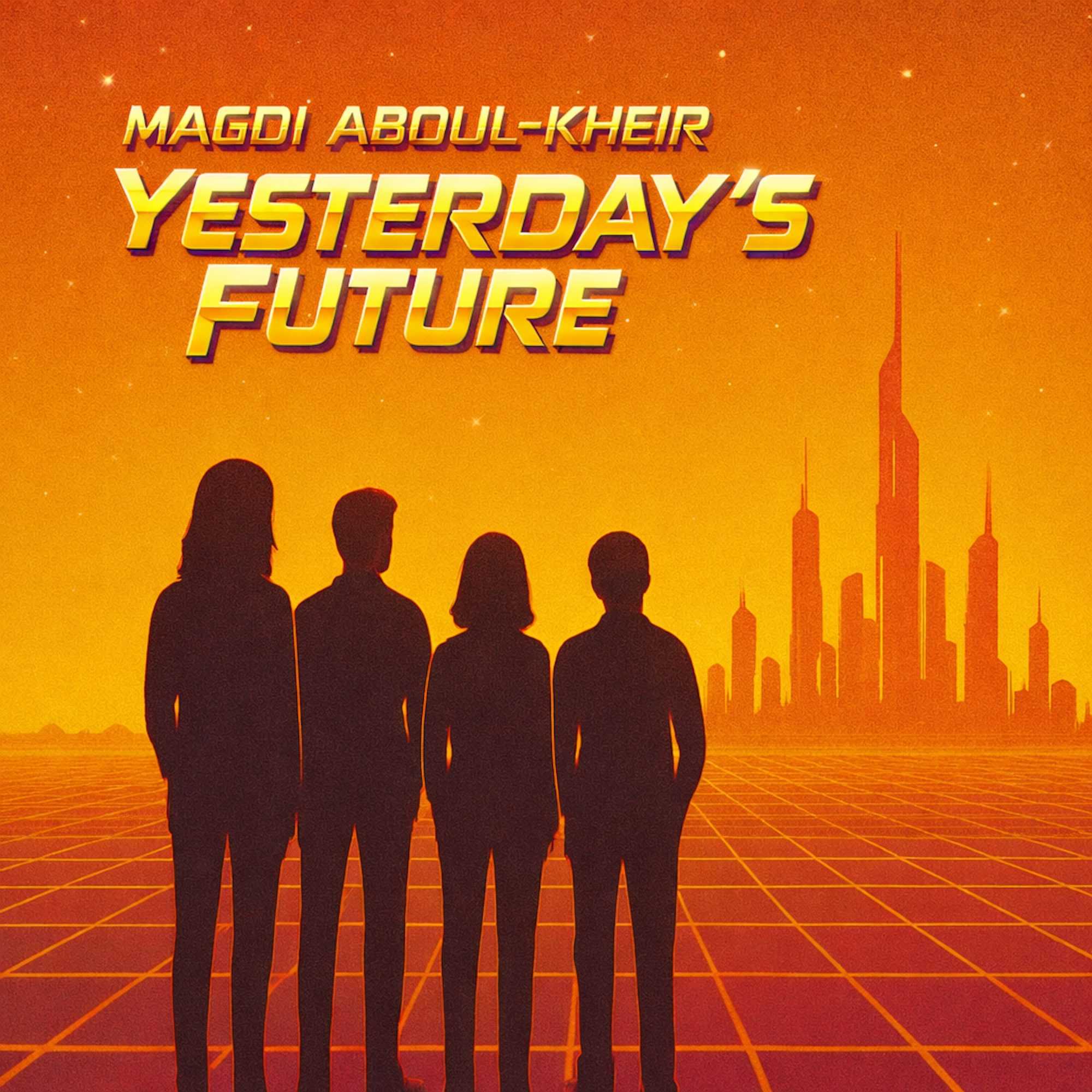
Magdi Aboul-Kheir's Yesterday's Future is a joyful trip back to the future people once imagined. Inspired by the sounds and ideas of the 1980s, the album brings together synthesizers, drum machines, soaring guitars, and rich string arrangements, giving these familiar elements a fresh, modern feel. Rather than recreating the decade exactly, Aboul-Kheir treats its musical language as a creative playground, letting curiosity, freedom, and emotion guide the process.
The album also reflects his fascination with time and how yesterday, today, and tomorrow connect. Through its melodies, rhythms, and atmosphere, Yesterday's Future explores energy, optimism, momentum, contemplation, and the sense that everything is always changing. Influences from 1980s films and television, including Knight Rider and Blade Runner, help shape its neon-lit, futuristic mood.
With a musical journey spanning orchestral, chamber, ambient, jazz-inspired, and vintage electronic styles, Aboul-Kheir keeps exploring new creative worlds without being boxed in by genre.
In this interview, he discusses the inspiration behind Yesterday's Future, his connection to 1980s music, the importance of melody and emotion, and his hopes for where his music will go next.
Follow Magdi Aboul-Kheir on
https://open.spotify.com/album/2e1DwKtNWGKiuIixp9TgVd?si=a-kQ99S9Q8emLnGxrl_fnw
Listen to Yesterday's Future
Facebook
Spotify
Soundcloud
Bandcamp
Instagram
Congratulations on the release of Yesterday's Future. The album feels like a celebration of the future people once imagined. What sparked the idea behind this concept, and what inspired you to bring it to life?
Thank you! The idea was simply to have fun. From a musical perspective, the influence of the 1980s is still very much alive today, especially in electronic music. I was fascinated by the idea of taking the sounds, patterns, and musical ideas of that era and transforming them into something fresh with curiosity and joy—not as a purist exercise, but as a creative reinterpretation.
On a more philosophical level, I'm endlessly fascinated by the nature of time. How do we look back at the past? How consciously do we experience the present? And how do we imagine the future? What endures, what changes, and what disappears? Exploring these questions through music felt like a natural extension of the album's concept. And, in the end, it was tremendous fun to create.'
Yesterday's Future is filled with the sounds of '80s synthesizers, drum machines, soaring guitars, and rich string arrangements. How did you blend these classic elements while making the music feel fresh for today's listeners?
I approached it by not trying to be a purist. Instead, I treated the musical language of the 1980s as a creative playground. Rather than recreating the era exactly as it was, I wanted to take its sounds and aesthetics and shape them into something that speaks to today's listeners. In that sense, it's a journey through time—but one that ultimately arrives in the present.
The album captures a sense of fun, nostalgia, and energy from beginning to end. How important was it for you to balance those retro influences with your own musical identity?
It was important, but it also happened quite naturally. I never saw it as a challenge or a contradiction. The musical influences of the 1980s—when I first developed my musical voice—have simply become part of my vocabulary. They're woven into the way I write music, so in many ways they are already an essential part of my musical identity.
I never saw it as a challenge or a contradiction
Your work spans many styles, from orchestral and chamber music to ambient, jazz-inspired instrumentals, and vintage electro. How has exploring such different genres influenced the way you approached Yesterday's Future?
It gives me the freedom and the courage to play with musical elements without any preconceived boundaries, using whatever inspires me and whatever feels right for the music.
As a pianist and composer, you often say that emotion guides your creative process as much as technique. How did that philosophy shape the melodies and atmosphere of this album?
Together with the sounds and rhythms, the melodies are meant to express what lies at the very heart of the album: the flow of time and the connection between yesterday, today, and tomorrow. They reflect energy, momentum, and optimism, but also moments of contemplation and a sense of transience.
Yesterday's Future builds on the retro direction you introduced with Into the Retroverse. In what ways do you feel this new release expands or refines that musical journey?
I felt even freer in the way I approached the musical material. And I hope that this freedom is reflected in the flow of the music—that it feels even more natural and effortless.
Your recent releases have explored very different musical worlds, from the peaceful soundscapes of Nubes Sonorae to the intimacy of Slow Heat and the romantic orchestral writing of The Garden of Make Believe. How does Yesterday's Future reflect another side of your creativity?
Every album expands my musical spectrum and teaches me something new. With Yesterday's Future, I had the opportunity to revisit and reflect on a musical world that was especially meaningful and formative for me as a young person: the synthesizer sounds of the 1980s.
https://open.spotify.com/artist/1c08FX1SRwfw1pxUc32dTB
The album paints vivid images of neon lights, robots, and futuristic adventures that many people grew up imagining. Were there any particular memories, films, or cultural moments that helped shape its atmosphere?
I hope it’s not the fashion I wore back then that inspired it! Seriously though, many images from the TV series and films of that era came back to me: the fast cuts, the neon colors, and the science-fiction visions. In a way, it was everything from Knight Rider to Blade Runner.
Your music is known for being expressive and highly melodic, no matter the genre. Why is melody such an important part of your songwriting, and how does it help you connect with listeners?
I believe that a strong melody can carry and communicate the very essence of what I want to express. And when that connection works, it gives the listener a way to engage with the music on an emotional level.
With Yesterday's Future now out in the world, what do you hope listeners take away from the experience, and where do you see your musical journey heading after revisiting the future of the past?
I simply hope that people enjoy listening to the album and have fun with it. Moving forward, I want to continue exploring different genres—discovering new musical worlds while still staying true to myself.





No comments:
Post a Comment