|
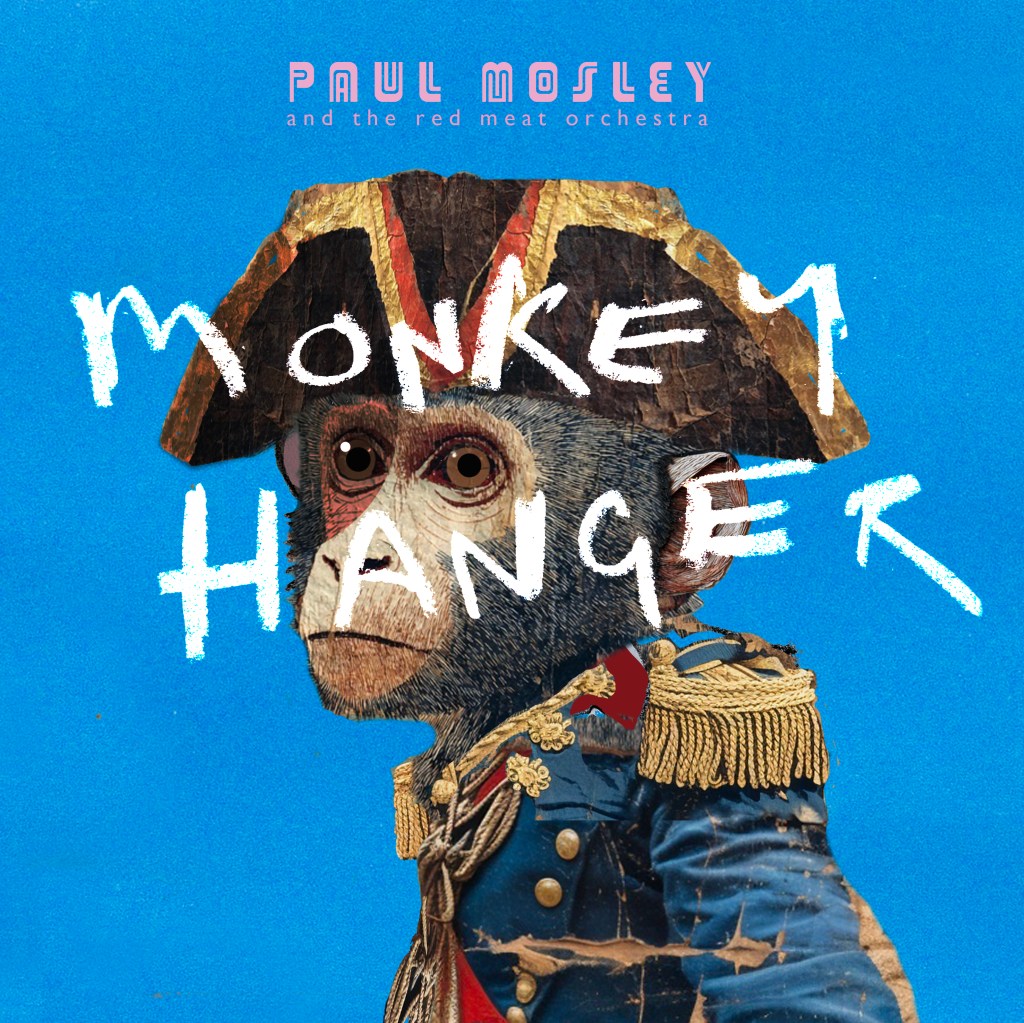
For more than two decades, Paul Mosley has been sewing a career defined by a rich tapestry of folk, Americana, jazz, and chamber-pop. Spending five years creating award-winning music for puppet theatre, Mosley is back with his latest album, Monkey Hanger, which hits streaming July 31st, 2026. This marks his eleventh solo album and the fifth one featuring his talented group, the Red Meat Orchestra. |
The album is filled with lyrically intriguing, heartfelt songs that reflect on memory, belonging, and the unique experience of growing up gay in the North East of England during the 1980s. |
In Monkey Hanger, Mosley draws his inspiration from the notorious folktale of Hartlepool, a story that was originally used to poke fun at the town, but has since been embraced as a source of local pride. The album serves as a conversation across time, focusing on a life-altering night at the beach in 1989 when a young Mosley was trying to understand himself, breaking down those layers of self-realization common in young people. |
Throughout the album, the Red Meat Orchestra adds depth by mixing jazz influences, 80s synth sounds, and elements from international theater artists Mosley has worked with in the past. This blend strikes as a balance between personal songwriting and ambitious musical arrangements. Notable contributions come from guests like Tom Moth, known for his work with Florence & The Machine, and Colin Smith who has worked with Feist and Madness. |
Built around a warm guitar, soft bass, and subtle layers of keyboards, “Sleep on the Beach” feels like one of the album’s most reflective moments. The instruments create an atmosphere of quiet isolation, while the arrangement has an almost folk-rock quality, allowing Mosley’s voice to remain the emotional centerpiece rather than overwhelming the listener with elaborate production. |
Symbolically, the beach represents a place between certainty and uncertainty, where land meets sea, much like the youthful version of Mosley standing between childhood and adulthood. It captures the loneliness of growing up but also the comfort found in nature and solitude, suggesting that moments of vulnerability are necessary for personal growth. |
One of the album’s most eccentric and symbolic pieces, “Revenge of the Heartpool Monkey,” combines energetic guitars, driving drums, expressive bass lines, and playful instrumental flourishes that create an unpredictable, almost theatrical atmosphere. This song feels like the moment where bottled-up feelings finally rebel. |
The energetic instrumentation mirrors emotional chaos, while sudden dynamic shifts reinforce the idea that emotions rarely behave logically. The “revenge” isn’t directed at another person so much as at the narrator himself. It frames emotional release as an important step towards self-awareness, suggesting that accepting one’s flaws and impulses is part of becoming emotionally mature. |
Another track of note, “Captain I Confess,” serves as one of the emotional centers of the record. The instrumentation leans toward a slower, more deliberate arrangement featuring acoustic guitar, piano, restrained percussion, and occasional orchestral textures from the Red Meat Orchestra that gives the song a confessional, almost cinematic feeling. |
The song becomes an acknowledgment that no one truly has everything figured out. Rather than portraying vulnerability as weakness, Mosley presents confession as liberation, arguing that genuine growth begins only after abandoning the illusion of complete control. |
Despite its lighthearted title, “Scooby Doo”, is far more emotionally layered than it first appears. The song likely draws upon childhood nostalgia, using the familiar cartoon reference as a symbol of innocence and simpler ways of viewing the world. Musically, it has a brighter, more playful character than many surrounding tracks, with lively guitars, rhythmic drums, melodic bass, and an upbeat temp that masks the underlying sense of longing. The reference to Scooby-Doo becomes shorthand for a time when every mystery could eventually be solved, whereas adulthood presents questions with no easy answers. |
In the end, Monkey Hanger is a remarkable addition to Paul Mosley’s extensive body of work. The album is explorative, reassuring, and introspective. Reminding both that young boy on the beach and the listeners today that the journey ahead is full of light and love. |
|
|
|
|





No comments:
Post a Comment