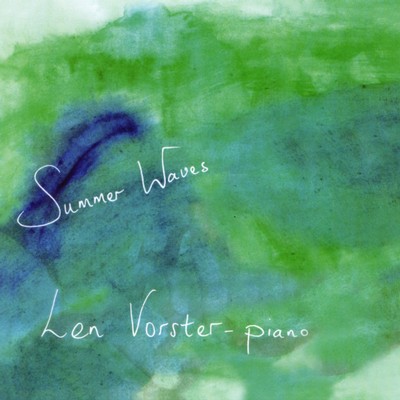
SUMMER WAVES
Len Vorster
Move Records MCD 661
This must be a re-issue because the pianist's copyright on it goes back to 2004 and the credits listed on the slim leaflet point to original production and design by an entity called MANO MUSIC. This organization is listed as a Norwegian company and the sort of music it publishes these days is (as far as I can tell) soft-core pop. Whatever the history, here is Len Vorster's CD under the Move label and this musical content is impressive, if much of it is light. Still, that's only to be expected when the background to the recording are this musician's recollections of his youthful holidays by the sea in South Africa.
The leaflet also notes that Vorster is celebrating the centenary of one of the composers he performs: Lennox Berkeley, who was born in 1903 - which puts the recording into an even firmer temporal location. Mind you, it also means that these liner notes have not been updated; more to the point, a biographical screed printed here on Vorster is also possible to date from 2004 or thereabouts because his career details after that time remain unrecorded.
The CD opens with Gershwin's three Preludes of 1926, familiar pieces that betray a sort of compositional constriction despite the ebullience of the outer numbers. Then we have a clutch of disparate pieces by de Falla: Cancion (1900), Serenata (1901), Nocturno (1896), Serenata Andaluz (1900), Vals-capricho (1900). Two pieces by Lord Berners follow - a 1941 Polka and a 1943 Valse. Continuing the sudden British detour, Vorster airs the 1945 Six Preludes for Piano by Berkeley. Two nocturnes follow - one in B flat Major of 1817 by Mr. Nocturne, John Field; the other more well-known one coming from Grieg's Lyric Pieces of 1891. Then it's all Gallic fun with Debussy's La plus que lente waltz of 1910, Poulenc's Les chemins de l'amour song dating from 1940 but here pianized, and Ravel's Valses nobles et sentimentales of 1911 - at close to 15 minutes, the longest track on this recording.
As you'd expect, the so-called 'jazz' preludes enjoy an expert airing, the first Allegro not exactly in synch with the published dynamic markings and a heavier accent than most on the last quaver chord in bars 4 to 6, and later when that bass support pattern emerges. But there's a delicious elegance in the forte-to-piano run pf demi-semiquavers across the penultimate bar and Vorster maintains his syncopated initiative from first bar to last. He takes the middle 'blues' prelude slowly and doesn't really press forward during the middle F sharp Major interlude, taking the right path out of a contradiction between a tempo and largamente con moto.
And I liked the alternation between arpeggiating some of those 10th left-hand stretches and landing the notes together; sort of in keeping with the relaxed ambling pace of the composition's most successful pages. For the final Allegro prelude, Vorster maintains a consistent rhythmic and dynamic output; my only complaint is that the final statement of the theme in octaves across the score's final 8 bars impresses as hard-won rather than the virtuosic powerhouse made of it by other interpreters.
Fall's Cancion follows Gershwin's ternary shape and stands as an unremarkable, melancholy piece of salon music with a deftly reinforced re-statement of the composer's balanced tune. A bit more national colour flavours the Serenata which is given with an agreeable rubato that invests the piece with a quasi-improvisatory ambience, even if all the notes are there to be articulated - in this case, with great sympathy. Not much distinguishes the Nocturno, apart from an infectious descending figure of two demi- and one semiquaver across a Major/minor 3rd; which lends the piece a kind of Andalusian kick. Otherwise, it's a Chopin rip-off with no claims to longevity.
Speaking of that province, we come next to another serenade in the Serenata Andaluz which is a tad more diffuse in its shape than its precedents by this writer. Here, the colours applied have a very familiar character, not least the triplet that comes at the start of the bar which concludes several of the main tune's phrases (after we get to a tune, 16 bars after a frippery-filled preamble). The piece oscillates between D Major and minor, expanding to a polonaise-rhythm coda that eventually recalls the decorative opening as de Falla harvests his material - sort of. But Vorster's reading is infectious and eloquent.
After this composition, we enjoy yet another just as fulsome in its expression. The Vals-capricho is an ebullient piece of semi-virtuosic salon music, certainly more digitally challenging than anything we've heard in the Spanish composer's output so far. The performance is excellent, finding out the rather trite sentiment and its flashy expression, maintaining a steady pulse throughout, handling the right-hand flights in alt with obvious mastery.
But it's about this stage that I started to wonder about the relationship between Gershwin's brassy combination of Latin rhythms and jazz, de Falla's ambivalent unhappy fusion of his country's folk music with the effete 'art music' of his youth, and Vorster's summertimes at home in South Africa. You might call it all holiday music, possibly: nothing heavy, most of it pretty skittish, a lot of it amiable and forgettable. And the vivacity keeps on coming with the two dances by Berners, the Polka a heavy-handed romp with a penchant for ending a phrase on an inappropriate note, but the atmosphere jaunty and vulgar in a 1920s style - impossible to imagine without its generic forebear in Walton's Facade of nearly 20 years previous. Vorster sounds comfortable with the piece's flourishes and loud peroration, but the piano sound is inclined to be harsh and jangly.
The Waltz is longer as well as more polished in its modulation scheme and shape. Vorster performs it with a liberal rubato and plenty of languid hesitations but the most interesting element lies in its irregular phrase lengths and the whimsical interchange of the anticipated with the eccentric. You wouldn't call it a serious dance by any means but you are drawn in by its impetus and spiritedness. Both these Berners pieces are emphatically tonal; any of the contemporary experiments and rule-breaking that the composer would have been more than well aware of, considering his rich field of acquaintances, find no place in his own work.
You have to assume that the inclusion of Lennox Berkeley's Six Preludes would be partly due to Vorster's friendship with Michael Easton, a pupil of the venerable English composer. While you might find traces of holiday romps in Berners' frivolities, these almost contemporaneous pieces have more gravitas to them. The first, Allegro, is a serious near-toccata with a continuous run of triplets underpinning the aggressive chords that constitute the central matter. As becomes the pattern in the series, the second prelude is much more relaxed in tempo, a slow-moving Andante, following a recognizable developmental path and staying within the rather sophisticated harmonic boundaries that Berkeley set himself.
No. 3 of the set, Allegro moderato, is the shortest and another busy construct, loaded with purposeful activity and clever in its progress, if not leaving much to roll around the tongue. The following Allegretto is a slow-moving waltz based on a simple enough melody memorable for a mid-motion demi-semiquaver snap, its evolution cloaked in a sequence of ever-mobile modulations; the whole finely realized by Vorster whose delivery is both deliberate and insouciant.
No. 5 is an Allegro whose outer segments appear to be in 7/8, the central page moving to a regular 6/8. The material is light-hearted at either end with a piquant, elliptical stepping melody that is subjected to less stressful handling than its predecessor. Finally, the longest of these preludes, another Andante, takes us back to the quiet and contemplative ambience of the other even-numbered pieces, serving as a rather sentimental envoi to the set, here handled with excellent suppleness. Berkeley's work, more than anything so far on this album, might suggest the happy days of the performer's youth, if one spent in elevated company.
An odd miscellany follows, starting with Field's Nocturne No. 5 that is distinguished for its gentle charm and dexterous right-hand writing, Vorster takes his time over the fioriture but gets to the heart of the gentle sentiment that colours these two pages. He brings admirable breadth to Grieg's Notturno, notably the concluding nine bars where he makes a good deal out of the composer's sleight-of-hand coda. As well, you have to admire the precision of those quiet, exposed trills in bars 16, 19, 57 and 60.
We end in France, first with Debussy in slower-than-slow mode. Here, the rubato direction is employed fully and the interpretation is one of quite legitimate pushes and pulls, fits and starts, action and languor. Even if it was written as a benign satire, La plus que lente is a highly effective, moody score that oozes seductiveness, more persuasive than pretty much anything else in the belle époque's musical output. Poulenc's waltz-song, originally to Anouilh's words, has a genial spirit with a considerable sweep to it, but it seems to me to be indistinguishable from many others of its type. Further, its language smacks of the music hall and presents as simplicity itself when compared to its Debussy companion. As we've come to expect, Vorster's reading is excellent: an enthusiastic rendition of a piece of fluff.
Ravel's collection of eight waltzes is remarkable as an extended essay in pianism if unsettling in its juxtapositions of tonal high spirits and bitonal or added-note chords in eventually-resolved discord-to-concord movement. Each of the constituents, apart from the concluding Epilogue Waltz 8 which is a downward-looking Lent, passes by rapidly. There is a kind of contrast available - for instance, the stentorian call-to-arms of the first Modere - tres franc, followed by the 7th-rich ambivalence of the following Assez lent. But the impression is of studied cleverness in the clashing thirds and fourths that pepper the No. 4 Assez anime which in turn is set alongside the quiet appeal of the lilting pp and ppp calm of Ravel's Presque lent No. 5.
I'm not much of a fan of the middle F Major (ostensibly) pages in No. 7 where the accents get displaced and the outcome is a blurred mess; not Vorster's fault but a triumph of smartness over sense. Still, the final quietly resonant pages with their premonitions of Britten's Moonlight interlude bring this odd, challenging miscellany to a cogent end. Yet, for the last time, I have to wonder how these off-centre waltzes put us in mind of holidays. To me, they anticipate the 1920 La valse which some see as a glorification of the dance form, while the rest of us find it close to a post-war nightmare.




No comments:
Post a Comment