Download free music MP3s on genuine quality, the world’s largest online music catalogue, powered by your scrobbles. Free listening, videos, photos, The world’s largest online music catalogue, powered by your scrobbles. Free listening, videos, photos, stats, charts, biographies and concerts. stats, charts, biographies and concerts.
Sunday, June 9, 2024
MiniDexed Quad DAC PCB Design
This is the design for a MiniDexed IO board for the Raspberry Pi 5 that supports four GY-PCM5102 modules as described here: RPi 5 Quad Stereo Sound with PCM5102A. Warning! I strongly recommend using old or second hand equipment for your expe…
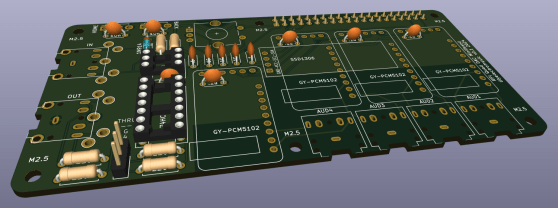
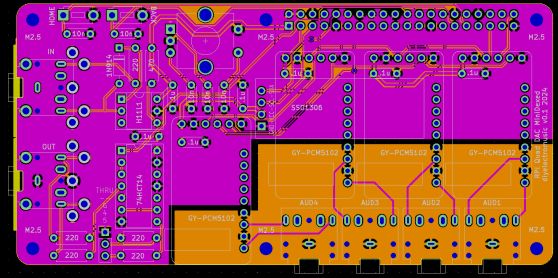
This is the design for a MiniDexed IO board for the Raspberry Pi 5 that supports four GY-PCM5102 modules as described here: RPi 5 Quad Stereo Sound with PCM5102A.
Warning! I strongly recommend using old or second hand equipment for your experiments. I am not responsible for any damage to expensive instruments!
If you are new to single board computers, see the Getting Started pages.
The Circuit
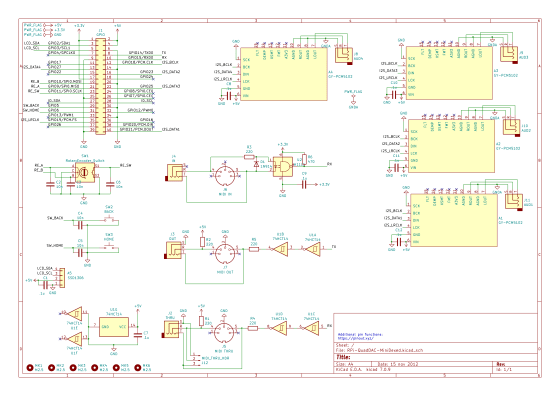
This is based on my MiniDexed Raspberry Pi IO Board including provision for a SSD1306 OLED display, two buttons, MIDI IN, OUT and optional THRU and a rotary encoder.
It includes connections for four GY-PCM5102 modules using the four I2S lanes of the Raspberry Pi 5, but note that it is not intending to use the built-in 3.5mmm stereo output of any of the PCM5102 modules but instead will hook up additional 3.5mm TRS sockets to the audio L/R/GND additional pins.
It uses the following GPIO pins:
3.3V
MIDI power
5V
PCM5102 and SSD1306 power
GND
GPIO 2/3
LCD SDA/SCL
GPIO 9/10/11
Rotary Encoder
GPIO 5/6
Back/Home buttons
GPIO 18/19
PCM5102 BCK/LCK - common
GPIO 21/23/25/27
PCM5102 DIN – Modules 1-4
GPIO 14/15
TX/RX MIDI
PCB Design
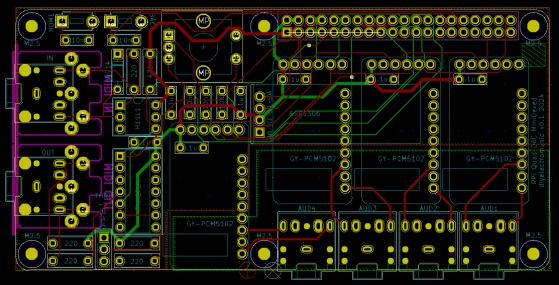
The design allows for either DIN or TRS MIDI sockets. The DIN sockets are mounted underneath the PCB whereas the TRS sockets (if used) will be on top with the other components.
The (2.5M) mounting holes align with the mounting holes on the Raspberry Pi.
The decoupling capacitors for the GY-PCM5102 modules have been positioned underneath the modules themselves. This means they can either be bent flat or soldered onto the underside of the board.
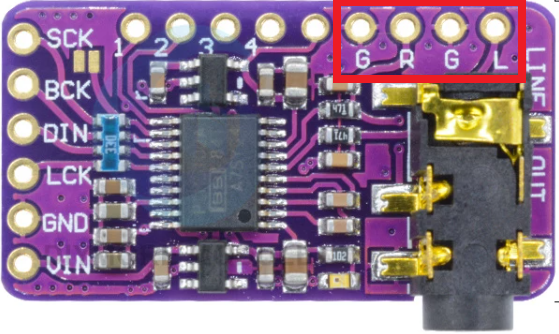
I've kept the analog/audio ground section distinct from the rest of the digital board. Each PCM5102 module has additional audio outputs in the additional row of pins as follows:
In order, these pins are GND - right - GND - left and the board routes these to the R/L channels of the associated audio out stereo TRS socket.
MIDI THRU is left as an optional addition via the use of jumper headers.
Closing Thoughts
To be honest, I was quite surprised that all this fitted into a sensible Raspberry Pi-shaped footprint, but it does!




No comments:
Post a Comment